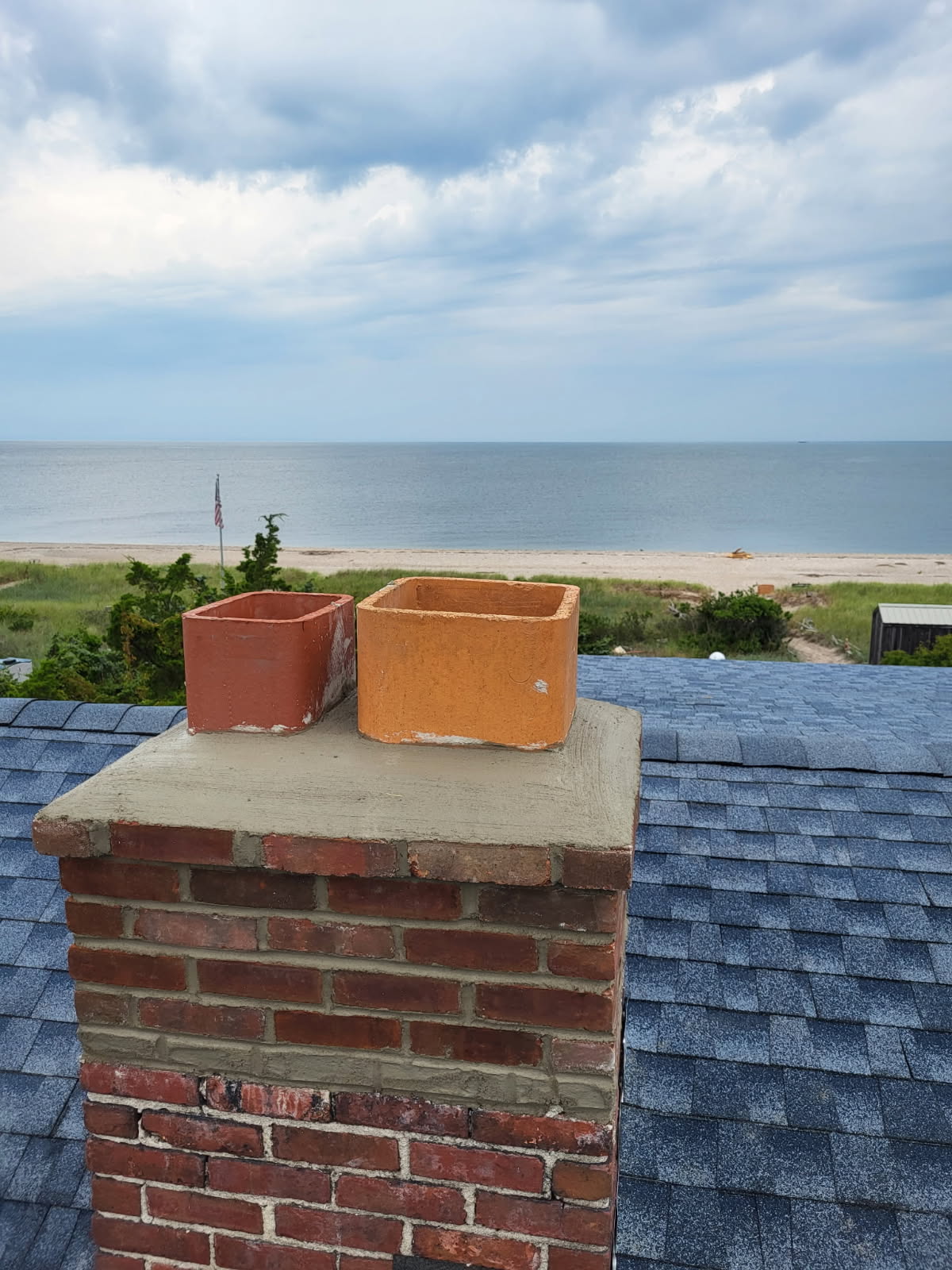
Chimney repointing means cutting out failed mortar joints and packing in fresh mortar. It's the right fix when the brick is still sound and only the joints have worn. Look for mortar crumbs at the base, joints you can scrape out with a key, and visible gaps. Widespread spalling or leaning calls for a rebuild instead.
Five signs your chimney needs repointing
Most of this you can spot from the ground with a pair of binoculars. First, sand or mortar crumbs collecting on the roof shingles, in the gutter, or at the base of the chimney. That grit is the joint coming apart.
Second, joints you can scrape with a house key or a screwdriver. Sound mortar resists a key. Mortar that powders away under light pressure is done. Third, visible gaps — spots where you can see daylight or sky through a joint, or where the mortar has receded well behind the face of the brick.
Fourth, brick faces that are flaking, pitting or popping off. That's spalling, and it usually means water has been getting in for a while. Fifth, stains on the ceiling or the wall below where the chimney passes through the house. Water that reaches drywall has been inside the masonry long before it showed up indoors.
Why chimney mortar fails faster than the rest of the house
A chimney is the most exposed masonry on a Long Island home. A wall on the side of the house gets weather on one face. A chimney gets it on four faces plus the top, with nothing above it and no overhang protecting it.
Add wind-driven rain off the Sound and the ocean and full freeze-thaw cycling all winter. Water soaks into the joints, freezes, expands, and pushes the mortar apart a fraction at a time. We wrote more about that cycle in our post on how Long Island winters damage concrete and masonry — the same mechanism works on a chimney, just faster because it is hit from every direction.
That's why a chimney often needs attention while the rest of the brickwork on the house still looks fine.
What repointing a chimney actually involves
The failed mortar gets cut out to a proper depth — deep enough to give the new mortar something to grip, not a thin smear over the top of the old joint. Surface skim coats look fine for a season and then fall out.
The joints are cleaned, dampened and packed with fresh mortar, then tooled to match the existing joint profile. Mortar colour and joint shape matter more on a chimney than on a wall nobody looks at. A chimney sits against the sky on your roofline and is visible from the street, so a patch in the wrong colour or the wrong profile reads as a repair from the curb.
Work on a chimney means staging or roof access, which is part of why the job takes longer than the same square footage of joints on a garden wall. See our masonry repairs service page for how we handle repointing, loose brick and stone repairs.
What usually gets handled at the same time
Repointing joints while water keeps pouring in from above doesn't hold. Three things above the joints are worth checking in the same visit.
The crown — the sloped masonry cap on top that sheds water away from the flue. Cracked or missing crown is one of the most common reasons chimney joints fail early. The cap or rain cover over the flue, which keeps water, leaves and animals out of the chimney itself. And the flashing where the chimney meets the roof, which is where a lot of the ceiling stains below actually originate.
When we look at a chimney we look at all of it, not just the joints we were called about. It is a false economy to repoint and then watch the same joints wash out two winters later.
When repointing isn't the right call
Repointing fixes joints. It does not fix brick. If the brick faces themselves are spalling across a large area, if the chimney leans, or if the top courses have shifted or opened up, you are looking at a partial or full rebuild from a sound point down.
Chimneys are often rebuilt from the roofline up, since the section above the roof takes the worst weather and is the part that moves first. We go through how to tell the difference in repointing vs. rebuilding brick.
On price, we don't quote chimneys sight unseen — too much depends on height, access, how much of the stack is involved and what the crown and flashing look like. Our post on what chimney repair costs on Long Island covers what drives the number. Every project is quoted on site after Andrew has looked at it.
Hiring a chimney mason in Suffolk or Nassau
Nassau County's Office of Consumer Affairs lists masonry work and chimney and fireplace builders, repairs and cleaners among the trades it licenses, along with waterproofing and retaining wall work. Check the current requirements directly with the county at Nassau County — Who Must Be Licensed? before you hire, since rules and categories change.
Our post on checking a Long Island masonry contractor's license walks through how to do that lookup.
Forte Brick and Concrete is family owned and operated. Andrew Capogna is on site for every project, and every job is handled start to finish, from the first visit through final cleanup. We work across Suffolk County and Nassau County by appointment, Monday through Saturday, and we offer a senior citizen discount — ask when you call. Call (631) 974-5285 or use the contact form and we'll come look at the chimney.
Frequently asked questions
How long does chimney repointing take?
It depends on how much of the stack is involved, the height, and how we get access to it. A chimney above the roofline is usually a shorter job than one being repointed its full height from the ground. We'll give you a realistic timeline when we quote the work on site.
Can you repoint only one side of a chimney?
Sometimes. The weather side often fails first and may be the only face that needs cutting out. But if we find the other faces are close behind, we'll tell you — doing one side now and the rest in two years means setting up access twice.
Is repointing the same as a chimney rebuild?
No. Repointing replaces the mortar between sound brick. A rebuild takes the chimney apart to a solid point and relays the brick. If the brick itself is spalling badly or the stack is leaning, repointing won't solve it.
Do you work in both Suffolk and Nassau County?
Yes. We cover Suffolk County and Nassau County. Call (631) 974-5285 or email fortebrickandconcrete@hotmail.com to set up a visit. We work by appointment, Monday through Saturday.
Should I have the chimney looked at before winter?
Fall is a good time. Repointing needs reasonable temperatures to cure properly, and getting open joints and a cracked crown sealed before the freeze-thaw season keeps a small repair from turning into a rebuild.