Repointing replaces failed mortar joints and leaves the brick in place. Rebuilding takes the masonry apart and relays it. The test is what is still sound: if the brick faces are solid and the wall is plumb, repoint. If brick is spalling, shifting or leaning, that section has to come down and go back up.
What is the actual difference between repointing and rebuilding?
Repointing is mortar work. A mason cuts the old, failed mortar out of the joints, packs in new mortar and tools the joint so it matches what is already there. The brick never moves. Done properly it stops water from getting into the wall and buys you decades.
Rebuilding means the masonry comes apart. The brick is taken down course by course, the bad units are discarded, and the section is laid back up on sound masonry below. It costs more and takes longer, but there is no mortar on earth that fixes a chimney that is leaning or brick that has lost its face.
Most of the calls we get in Suffolk County are somewhere in the middle, and that is fine. The honest answer is usually that part of it needs mortar and part of it needs to come down.
Five things you can check yourself before you call anyone
First, take a key or a screwdriver and scrape a mortar joint. If it crumbles into sand under light pressure, the mortar has given up. Second, look at how deep the joints are set back. Joints recessed more than about a quarter inch past the brick face are holding water, not shedding it.
Third, look at the brick faces themselves. Flaking, pitting or a face that has popped off and left a rough orange interior is called spalling, and it means water got into the brick and froze. Mortar will not bring that brick back.
Fourth, follow any cracks. A stepped crack that runs through the mortar joints is often a repointing job. A crack that runs straight through the brick units themselves is a movement problem and needs a closer look. Fifth, stand back across the street and sight the chimney against the roofline. Any lean, bow or twist above the roof means rebuild, not repoint.
If you want the longer version of the mortar question specifically, we wrote about when to repoint brick on Long Island.
What a proper repointing job actually involves
The part people do not see is the cutting. The old mortar has to come out to a real depth, not just get skimmed over. The National Park Service guidance for repointing historic masonry calls for removing mortar to a depth of at least two to two and a half times the width of the joint, so the new mortar has something to grip (https://www.nps.gov/orgs/1739/repointing-mortar-joints-in-historic-masonry-buildings.htm). Smearing fresh mortar over soft old mortar is the single most common bad repair we are called back to fix.
The mortar also has to match, in strength and in look. A mortar that is harder than the brick around it does not protect the wall, it damages it — the brick ends up taking the stress instead of the joint. That is how you get spalling on a wall that was fine before someone repaired it.
Then there is tooling. The joint gets struck to the same profile as the original so the repair reads as part of the wall rather than a patch. That is most of what people mean when they say a repair blends in.
When rebuilding is the only honest answer
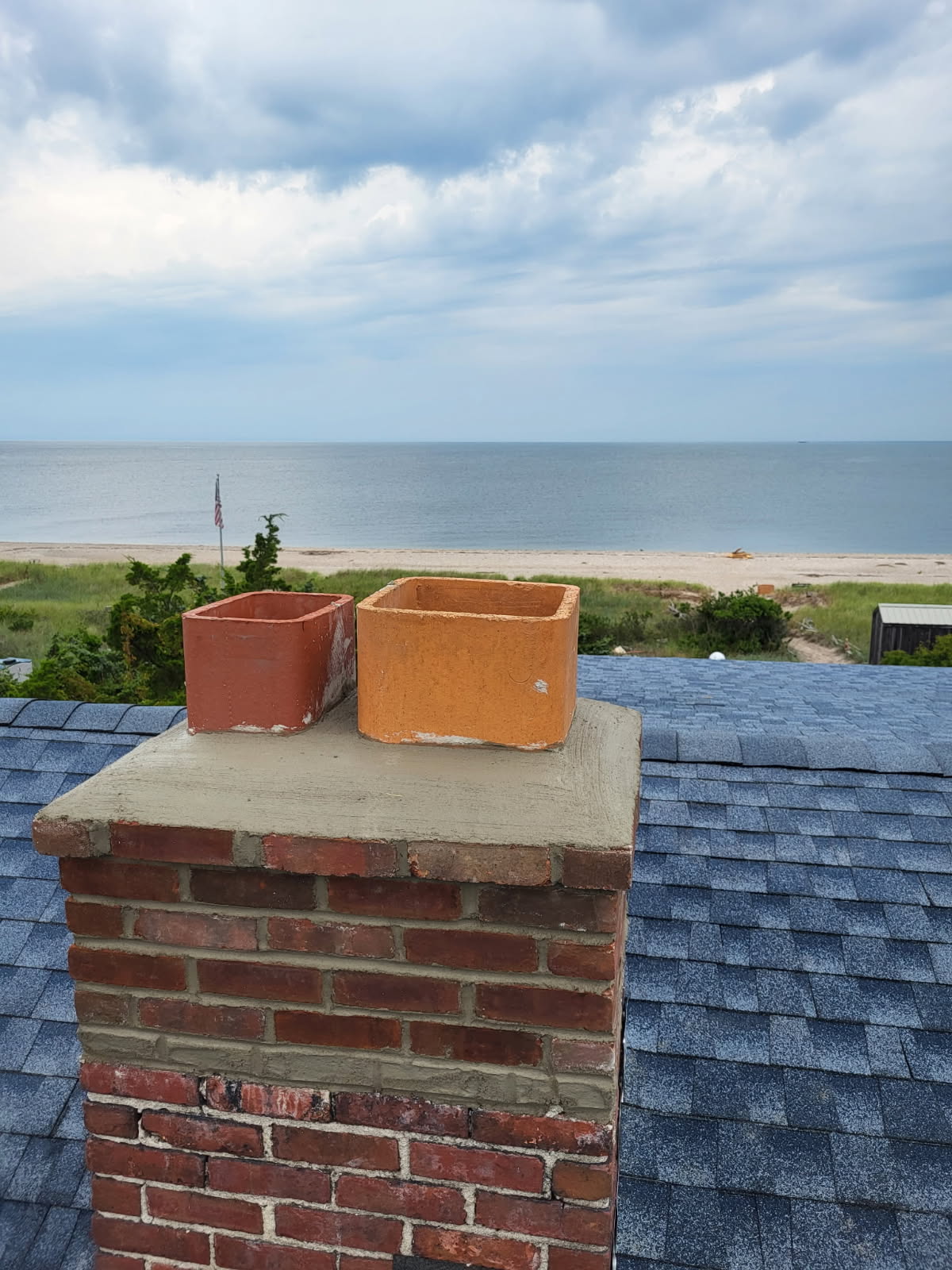
A failed crown is the usual starting point on a chimney. The crown is the concrete cap at the top that sheds water away from the flue. Once it cracks, water runs straight down inside the brickwork, and the top few courses go first. By the time you can see displaced or loose brick up top, mortar alone will not hold it together.
Displaced brick is the second sign — units that have shifted out of line, or that you can rock by hand. Masonry gets its strength from being stacked tight and bonded. Once that is lost, the only repair is to take it down to sound work and relay it.
The third is long-term water. If you have had stains on the chimney breast inside, a damp spot on an interior wall, or mortar that has washed out on one exposure over years, the damage is usually deeper than the face. We have rebuilt coastal chimneys where the outer wythe looked tired and the brick behind it came apart in our hands. You can see finished chimney work in our project gallery.
Why Long Island chimneys cross that line sooner
Three things gang up on brick out here. Freeze-thaw is the big one: water soaks into open joints and porous brick, freezes, expands and breaks the material from the inside. That cycle repeats dozens of times a winter on Long Island, which is harder on masonry than a climate that simply stays cold.
Wind-driven rain is the second. A chimney above the roofline has no shelter at all, and the south and west faces take the weather. That is why one side of a chimney is often soft while the other side still looks new.
Salt air is the third, and it is why we see South Shore and waterfront chimneys fail sooner than the same chimney three miles inland. Salt crystallizes inside the brick and mortar and pushes the material apart the same way ice does.
Is a partial rebuild an option?
Very often, yes, and it is usually the right money. On a chimney, that means taking the top courses and the crown down to sound masonry, relaying from there, and pouring a new crown with a proper overhang and drip edge. The lower section — the part protected by the roof — frequently gets repointed instead.
The same logic applies to walls. A section under a failed gutter can be rebuilt while the rest of the elevation is repointed. The goal is to replace what has failed and not charge you for brick that is still doing its job.
If a rebuild comes with other chimney work, our post on what chimney repair costs on Long Island walks through what drives the price. Every project is quoted on site.
What you should expect in a quote, either way
Ask what is being repointed and what is being rebuilt, in plain language, with the section named. Ask how deep the joints are being cut and how the mortar is being matched. Ask what happens to the crown. Ask what the cleanup looks like, because masonry work makes a mess and it should not be yours.
Be careful with a diagnosis given over the phone. Nobody can tell whether brick is spalled or just dirty from a description, and nobody should quote a rebuild without seeing the top of the chimney. We look at it in person and give you the options we would take on our own house.
Also check whether your work needs a permit. The Town of Brookhaven's building permit application lists fireplaces among the accessory structures it covers, and requirements differ town to town (https://www.brookhavenny.gov/DocumentCenter/View/36734/BUILDING-PERMIT-Application). Confirm with your own building department — Brookhaven's Division of Building is at One Independence Hill, Farmingville, 631-451-6333.
How we handle repair work at Forte
Forte Brick and Concrete is family owned and operated, and Andrew is on site for every job, start to finish — the first visit, the work itself, and the final cleanup. You are not getting one person for the estimate and strangers for the week after.
We handle masonry repairs across Suffolk and Nassau County: repointing mortar joints, loose or cracked brick, and block and stone repairs, done so the repair blends with what is already there. We also offer a senior citizen discount.
If you want a look at your chimney or wall, call (631) 974-5285 or use the quote form. Tell us what you are seeing and we will come out and tell you straight whether it is mortar or a rebuild.
Frequently asked questions
Can you match my existing mortar color?
In most cases yes. Mortar color depends on the sand, the cement and the lime, and a close match is made by sampling the existing joint. Older mortar has also weathered, so new work can read slightly brighter at first and tones down as it ages. We match the joint profile too, which matters as much to the eye as color does.
Will the repair be visible when it's done?
A well-cut, well-matched, properly tooled repair is hard to pick out from a few feet away. The visible repairs people complain about are usually mortar smeared over the brick faces, a wrong joint profile, or a patch that was never cut to depth. Blending the work in is part of the job, not an extra.
Can repointing be done in winter on Long Island?
It depends on the temperature, not the calendar. Mortar needs to cure before it freezes, so we watch the forecast and work when conditions allow rather than forcing it into a cold snap. Late fall through early spring on Long Island, we plan repair work around the weather and tell you honestly if it should wait.
How do I know if it's just the chimney or the whole wall?
Chimneys fail first because they are fully exposed on all four sides above the roof. A wall under eaves or shaded by the roof usually holds up longer. If you are seeing soft mortar at ground level or under a leaking gutter as well, that is a separate water problem worth addressing at the same time.
Do you handle both repointing and rebuilds, or just one?
Both. We do new masonry and repairs, which means we have no reason to push you toward the bigger job. If mortar will fix it, we will tell you that. If a section has to come down, we will show you why.