Chimney repair on Long Island falls into four levels, cheapest to most expensive: crown repair, repointing the mortar joints, rebuilding the brick above the roofline, and a full rebuild down to the firebox. Price follows the level of work plus height, roof pitch and whether scaffold is needed. Every chimney is quoted on site.
What are the four levels of chimney repair?
Almost every chimney job we look at in Suffolk and Nassau County lands in one of four buckets. Knowing which one you are in tells you more about cost than any number you find online.
Crown repair or replacement is the smallest job. The crown is the concrete cap on top of the chimney that sheds water away from the brick. When it cracks, water gets in and everything below it starts to go. Replacing a crown on an otherwise sound chimney is the least invasive work we do.
Repointing is the next level. The brick is fine but the mortar joints have washed out, so we grind out the bad joints and pack in fresh mortar. Repointing is priced by how much surface has to be cut and filled, not by the chimney as a whole.
A partial rebuild means taking the chimney apart above the roofline and laying it back up with new or salvaged brick and a new crown. This is the most common serious repair we do on older Long Island homes, because the section above the roof takes all the weather. A full rebuild goes further down, sometimes to the firebox, and is the largest and most expensive version of the job.
What actually drives the price?
Height and access come first. A chimney on a low ranch roof that we can reach from a ladder and roof jacks is a different job than a three-story chimney that needs staging built around it. Scaffold adds labor, setup days and equipment before a single brick is touched.
Roof pitch matters for the same reason. A steep pitch slows everything down and changes how we stage material and protect the shingles underneath.
How far down the damage goes is the other big factor. If the bottom two-thirds of the chimney is sound, we rebuild the top and you pay for the top. If the deterioration runs below the roofline, the scope grows, flashing comes into it, and the price moves with it.
Then there is the detail work: brick that has to be matched on an older house, a stone or stucco-faced chimney, a new crown poured with a proper overhang and drip edge. We do not publish a price list for chimney work because the honest answer only comes from looking at it. You can see the general scope of this kind of work on our masonry repairs page, and every project is quoted on site.
Why do Long Island chimneys fail in the first place?
Freeze-thaw is the main culprit. Water soaks into mortar joints and brick through the fall, freezes, expands, and pushes the material apart a fraction at a time. Do that over twenty or thirty winters and the joints are hollow and the brick faces start popping off. We wrote more about how that cycle works in our post on freeze-thaw damage to Long Island concrete and masonry.
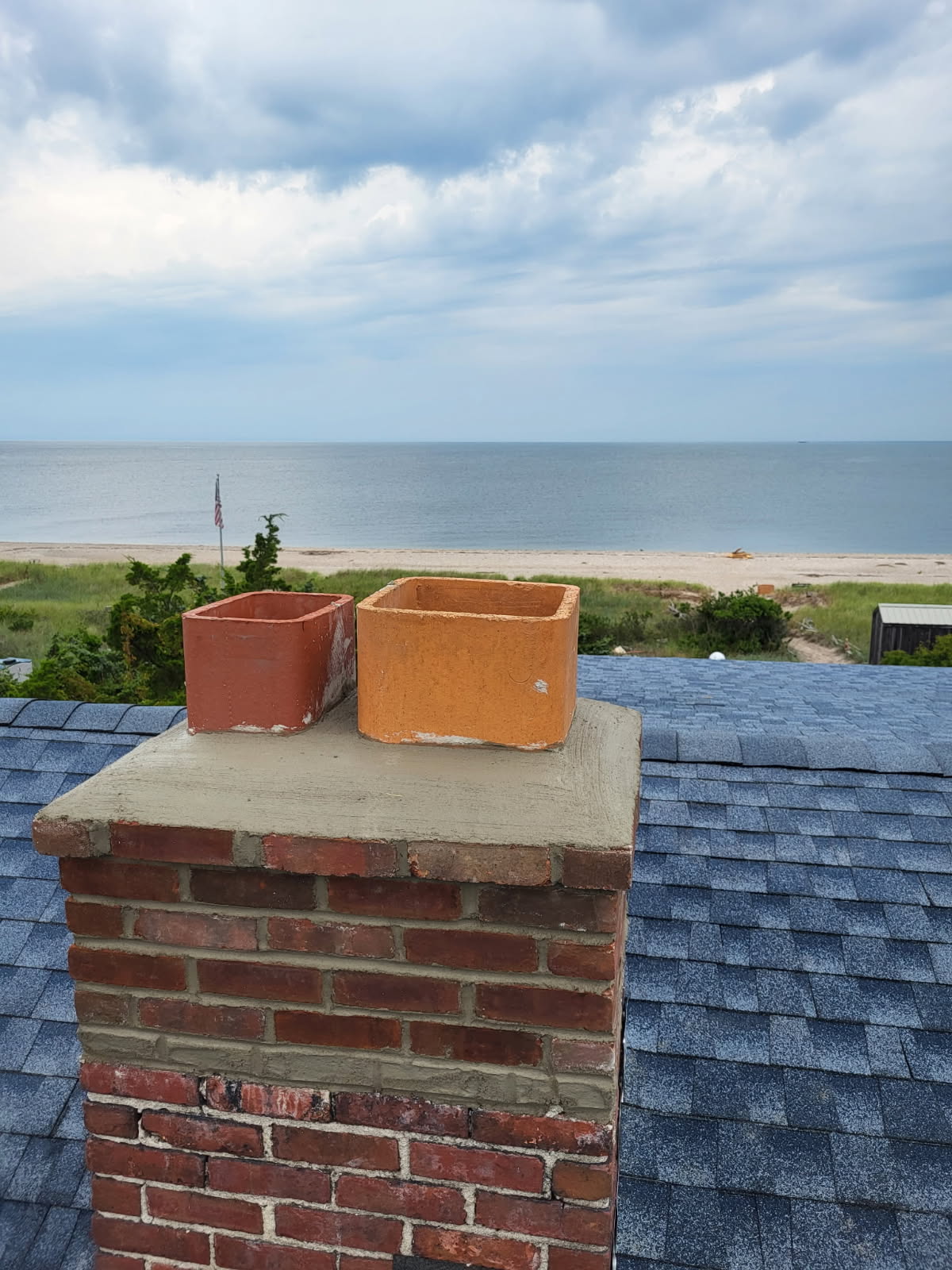
Salt air speeds it up. On the South Shore, the North Fork and anywhere close to the water, salt gets carried into the masonry and keeps the material damp and working. The coastal and waterfront chimney jobs in our gallery were both in that condition — weather from every direction with nothing between the chimney and the bay.
A chimney is also the most exposed masonry on your house. It has no eave over it, no wall sheltering it, and in most cases nobody has looked at it closely since the house was built.
How do I tell which level of work I need?
Stand back on the lawn with binoculars or use your phone camera zoomed in. You are looking for four things.
A cracked or crumbling crown. If the concrete cap is broken, spalling, or has gaps where it meets the brick, water is already going inside. Washed-out joints are the second sign — if the mortar lines are recessed, sandy or missing, the chimney needs repointing. Our guide on when to repoint brick on Long Island walks through how to judge that.
Loose, shifted or missing brick near the top usually means a rebuild of that section rather than a patch. Once bricks have moved, repointing around them does not restore the structure.
Staining, damp patches or a musty smell on an interior wall or ceiling near the chimney means water is getting in and traveling. That is the point to stop guessing and have someone come look. Chimney professionals across the region describe this same progression from crown and joint failure to brick deterioration and water entry — see, for example, Universal Roofing & Chimney and Long Hill Masonry.
What happens when you call us out for a quote?
Andrew comes out himself. He has been doing masonry on Long Island since 1981 and he is on site for every project this company takes, from the first visit through the final cleanup.
He will look at the chimney, tell you which of the four levels it is in, explain what he would do and why, and what he would leave alone. Then you get a price. We do not give chimney numbers over the phone before somebody has seen it, because the difference between repointing and a rebuild is thousands of dollars and nobody can tell which one it is from a description.
We are family owned and operated, we work by appointment Monday through Saturday, and we serve Suffolk and Nassau County. There is a senior citizen discount — ask when you call.
Repair or rebuild — the honest version
If the brick is sound and the mortar is the problem, repoint it. Repointing a solid chimney buys you many more years for a fraction of the cost of rebuilding, and anyone who tells you a chimney with good brick and bad joints has to come down should be asked to explain why.
If the brick itself is spalling, leaning, or the top courses have shifted, a rebuild of that section is the right answer. Repointing failed brick is putting new mortar around material that is already breaking apart, and you will be back in two or three years.
The in-between cases are the ones that need eyes on them. That is the whole reason we quote on site.
What this page covers and what it doesn't
We are masons. This page is about the masonry side of a chimney: the crown, the mortar joints, the brick and block, and rebuilding the structure. That is the work in our gallery and the work we do every season.
Questions about liners, flues, dampers, draft problems and sweeping are a different trade. If that is what you are dealing with, call us at (631) 974-5285 and we will tell you honestly whether it is our work or someone else's. We would rather send you to the right person than sell you the wrong job.
To get on the schedule for a look at your chimney, call (631) 974-5285 or send the details through our contact form.
Frequently asked questions
Can a chimney be repaired in winter on Long Island?
Masonry needs temperatures above freezing for mortar to cure properly, so cold stretches limit what can be done. Emergency work to stop water entry or secure loose brick can often be handled, with the full rebuild scheduled for better weather. Call and we will tell you what is realistic for the date.
How long does a chimney rebuild take?
It depends on the scope and the access. A crown replacement is a short job; a rebuild above the roofline that needs scaffold built, taken down and the work laid up in between runs considerably longer. Andrew will give you a schedule with the quote once he has seen the chimney.
Do you match the brick on an older house?
We work to match the existing brick as closely as we can in size, color and texture, and on partial rebuilds we often reuse sound brick from the chimney itself. On very old houses an exact match is not always available, and we will tell you that before the work starts rather than after.
Do I need a permit to rebuild a chimney?
Permit requirements vary by town on Long Island and depend on the scope of the work. Confirm with your town's building division before scheduling — for example, the Town of Brookhaven lists its residential permit types at brookhavenny.gov/602/Permits. We can tell you what the work involves so you can ask the right question.
Do you service both Suffolk and Nassau County?
Yes. We work throughout Suffolk and Nassau County, by appointment Monday through Saturday. Call (631) 974-5285 to set up a visit.