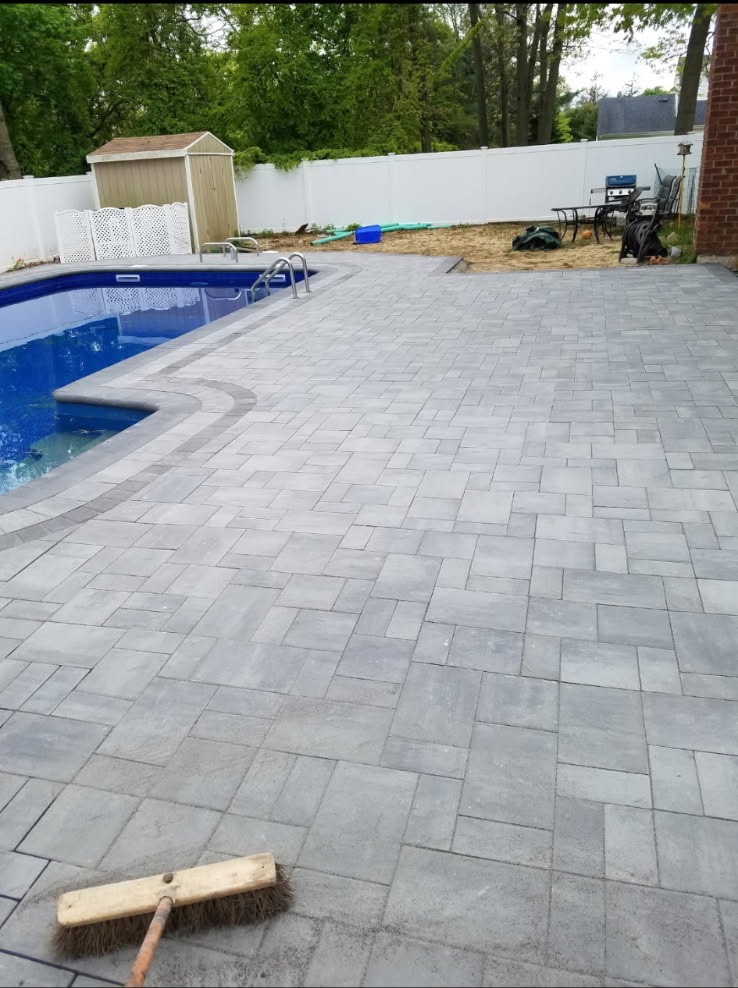
Most Long Island pool decks get replaced for three reasons: the concrete has cracked, sections have settled and now hold water, or the surface is too hot or too slick underfoot. A paver deck solves all three differently than a slab does, because individual units can be lifted and reset instead of broken out.
Why do Long Island homeowners replace a pool deck?
In Suffolk and Nassau, the pool deck is usually the first hardscape to go. It sits in full sun all summer, it gets soaked daily, and it freezes and thaws all winter with water still sitting in the joints and under the surface. A poured slab around a pool takes more abuse than a patio off the back door.
The three complaints I hear most are cracks running across the deck, sections that have dropped so water now runs toward the house or pools at the coping, and a surface that's either uncomfortable barefoot in July or slick when it's wet. Those are three different problems, and they don't all need the same fix.
If the deck is only cracked in one area and everything else is pitched right, a repair may be enough. If it's settled, cracked and draining wrong, you're replacing it. We'll tell you honestly which one you're looking at when we come out.
How do pavers behave differently than poured concrete around a pool?
The real difference shows up five or ten years in. A concrete slab is one piece. When ground under one corner settles, the slab cracks, and the only honest fix is to break out that section and pour new concrete that will never quite match the old.
A paver deck is hundreds of separate units sitting on a compacted base and bedding layer. When a spot settles, we pull up the pavers in that area, correct the base, and set the same pavers back down. No patch, no color mismatch, no saw-cut line across your deck.
That matters more around a pool than anywhere else on the property, because pool decks are the most likely place to see movement. There's backfill around the pool shell, there's irrigation, and there's constant water. If you want to understand the broader tradeoff between the two materials, we covered it in our paver patio vs. concrete patio comparison.
Where does drainage go wrong on a pool deck?
Pitch is the part that gets skipped, and it's the part that ruins decks. Water has to run away from the pool and away from the house. That means the deck is built on a deliberate slope, and the base under it is graded to the same slope before a single paver goes down.
A flat-looking deck isn't flat. If you stand at the coping and the water runs toward your feet, somebody got it wrong. The common DIY failure is setting the pavers level because level looks right, then watching water sit in the joints and work its way into the base all winter.
The other half of drainage is what's underneath. A properly built paver deck has a compacted stone base that lets water move through and out instead of trapping it against the pool shell. On the sandy soil in a lot of Suffolk County that works in your favor; where there's heavier soil, the base has to be built accordingly.
What happens at the coping, where the deck meets the pool?
The coping is the cap at the pool edge, and it's the transition that decides whether the whole job looks finished. The deck has to meet the coping cleanly, at the right height, with a joint that stays sealed and doesn't let water run behind it into the pool structure.
If you're keeping your existing coping, we work the new deck to it. If the coping is damaged or loose — which is common when the old deck has settled — it gets addressed as part of the job rather than left as the one old thing in a new deck.
This is also where the cut work shows. Pavers have to be cut to follow the curve of the pool, and sloppy cuts around a radius are the first thing anyone notices.
Which pavers make sense for a pool deck here?
We favor Nicolock and Cambridge products on our paver and hardscape work, and both lines include units made for pool decks. What matters for your house is the texture and the color, and those are decisions worth making with the sun exposure in mind — a deck with no shade behaves differently from one under mature trees.
Lighter colors generally stay more comfortable underfoot in direct summer sun than dark ones. Surface texture matters too, because a pool deck is walked on wet all season. Manufacturers and local installers both point to texture and slip resistance as the governing factors for pool-side applications; Unilock's Suffolk County paver notes and a Long Island paver selection guide both cover the same ground.
Bring samples outside before you decide. A paver looks different on a showroom floor than it does in the sun next to your house and your pool water.
What does a Long Island winter do to a pool deck?
Freeze-thaw is the reason a lot of pool decks fail early. Water gets into the surface and under it, freezes, expands, and works things apart. We've written more about what winter does to concrete here.
The base under the deck matters more than the paver on top of it. A well-compacted stone base that drains gives the water somewhere to go. A thin or poorly compacted base holds water, heaves in January, and leaves you with an uneven deck by April no matter how good the paver was.
That's the part of the job nobody sees and the part worth paying attention to when you're comparing quotes. Ask every contractor what the base is and how deep it goes.
When should you schedule pool deck work?
Plan it for the off-season. A deck replacement means equipment, excavation and material in your backyard, and you don't want that happening in the weeks you want to be swimming. Homeowners who get quotes in fall and winter get on the schedule for spring, ahead of the season.
Forte Brick and Concrete has been a family owned and operated Long Island business since 1981, serving Suffolk and Nassau County. Andrew Capogna is on site for every project, and we handle the job start to finish — first visit through final cleanup.
For a quote on a paver pool deck, call (631) 974-5285 or use the contact form. We offer a senior citizen discount, and every project is quoted on site.
Frequently asked questions
Can I put pavers over my existing concrete pool deck?
Sometimes, but it depends on the condition of the slab and the height at the coping and any doorways. If the concrete has cracked, settled or drains the wrong way, overlaying it just carries those problems forward. We'll look at the slab and tell you whether it's a usable base or needs to come out.
Do pavers get as hot as concrete around a pool?
Surface temperature depends mostly on color and sun exposure, not on whether it's a paver or a slab. Lighter colors stay more comfortable barefoot in full sun. If your current deck is uncomfortable in July, that's worth raising when we pick material.
How long does a paver pool deck replacement take?
It varies with the size of the deck, access to the backyard, and how much excavation the base needs. We give you a realistic window when we quote the job on site rather than a stock number over the phone.
What happens to the pool while the deck is being replaced?
The pool stays in place. The work happens around it, and the coping and pool edge are protected during demolition and excavation. We talk through how the backyard will be staged before we start.
Do you repair paver pool decks, or only replace them?
Both. If the pavers are in good shape and only a section has settled, we can lift that area, correct the base and reset the same pavers. That's one of the real advantages of a paver deck over a slab.